
Mars Amidst Praesepe Jewels, Orange vs Blue
Between 4th and 7th May 2025, Mars appeared to cross in front of the Beehive Cluster, a rare occurrence and the highlight of the astronomical week.
This week, the Red Planet appeared to pass through a celestial tourist waypoint, staying there for less than three days. This is Praesepe, better known as the Beehive Cluster, a stellar buzz of a thousand stars. The brief meeting was observed worldwide, even with the naked eye, as Mars and Praesepe have a bright apparent magnitude. Photographs revealed a stunning contrast between the orange and blue.
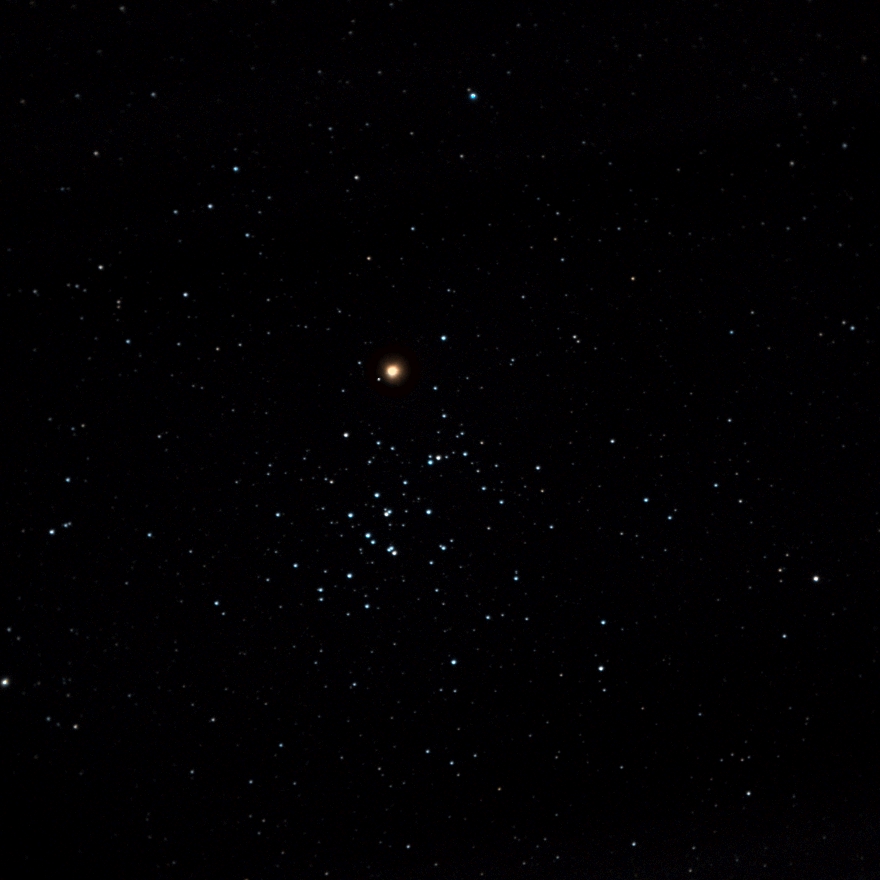
^Photographs revealed a stunning contrast between orange Mars and the blue Praesepe stars (Credits: Olesya Rtveliashvili)
How often does a planet pass in front of an open cluster? Such occurrences are infrequent as a planet’s apparent journey across the celestial sphere is confined to the narrow ‘zodiac band’. For a planet to pass in front of an open cluster, the cluster must be near the ecliptic or in a zodiacal constellation. For example, Venus previously crossed the Pleiades that is in the constellation of Taurus.
Aside from Mars’ and Praesepe’s stunning complementary colours, the Beehive Cluster (M44) is unique itself. Located in the constellation of Cancer, it is one of the brightest open clusters and home to around a thousand stars. Many belong in spectral class A, hence the cluster’s blue sparkle. It is filled with binary star systems and Delta Scuti variables (short period pulsating stars).
M44 also contains 40 Cancri: a rare ‘blue straggler’. This is a star that appears more luminous and blue than predicted. In this case, 40 Cancri has an extremely high surface temperature, making it the hottest in the cluster.
The next time Mars approaches the Beehive Cluster is in 2027 so until then, the planet waves a cosmic goodbye.
 Star Hunters