
At first glance, a star like Antares may seem like just one really bright star, outshining most of its companions in the sky. Secretly, the singular star is actually twins (or in rare cases, sextuplets!).
Some stars are naturally very luminous and massive on their own. Betelgeuse — a ferocious red giant in Orion. However, many bright stars are actually multiple very close together. Some of their separation is distinguishable by the naked eye. Otherwise, their secret twin has to be revealed using a telescope. Double stars are two stars that appear very close to each other in the night sky, separated into three categories.
Optical double stars are two stars that appear very close together in the sky but are actually completely unrelated. They are not gravitationally bound to each other and are separated by a significant distance. Their separation may be distinguishable with the naked eye, especially if both are bright. Visual binary stars — they are gravitationally bound to each other but their separation can still be observed with the naked eye or small binoculars. Spectroscopic binaries are like visual binaries but their separation was only discovered by a very powerful telescope or methods like spectroscopy. This typically applies for distant, small, dim binary star systems.
There are special cases. Mizar and Alcor: a popular double star, gravitationally bound to each other. As seen with the naked eye, they are clearly visual binaries. With a telescope, you can actually discover that Mizar consists of two stars — Mizar A and Mizar B. A binary within a binary! But it doesn’t stop there. Both of them are actually spectroscopic binaries along with Alcor. The double star is actually six stars!
Here are three constellations that contain many double stars, either seen with the naked eye, with an amateur telescope or even with a DSLR:
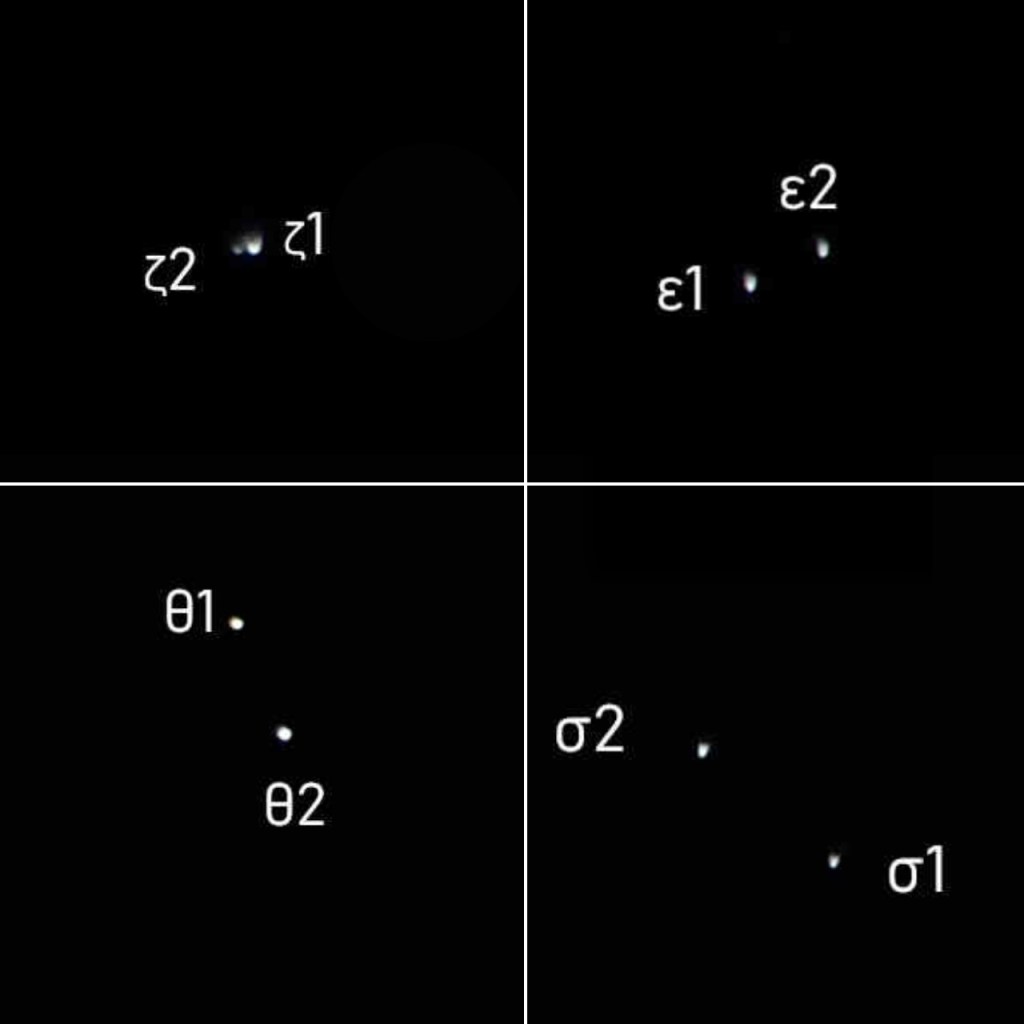
^ Going clockwise: Zeta Lyrae, Epsilon Lyrae, Sigma Tauri, Theta Tauri (Credits: Olesya Rtveliashvili)
- Lyra – a perfect starter double constellation: Epsilon Lyrae, Delta Lyrae, Zeta Lyrae
- Taurus– zodiacal constellation with many doubles: Sigma Tauri, Theta Tauri, Delta Tauri
- Scorpius– Milky Way doubles: Beta Scorpii, Mu Scorpii, Antares
There are many more constellations, especially close to the Milky Way, that have an abundance of double stars. Alternatively, you can look to the tip of Cygnus — Albireo is a double star (yet the two stars aren’t gravitationally bound to each other). One of the stars is a luminous golden and the other fake twin is a celestial blue.
 Star Hunters
Leave a comment