
As the Moon crosses the sky, it obscures many distant, dim stars. However, occasionally it passes in front of a bright star — or even rarer — a planet!
What is a Lunar Occultation?
Lunar Occultations are when the Moon passes in front of a celestial object, blocking the light so we cannot see it. They can only be observed from a small band on the Earth’s surface. This is because the alignment must be perfect in order to see the Moon pass in front of the object. The most common occultations are of luminous stars, namely Antares, Spica and Beta Tauri.
Lunar Occultations of Planets
Once or twice a year, the Moon obscures a planet in the night sky; these events are significantly more rare and can be captured by taking many photographs leading up to the occultation. Venus, Mars, Jupiter and Saturn are the planets that are most commonly occulted by the Moon. Again, lunar occultations can only be seen from a select few places on Earth. Elsewhere, a moon-planet conjunction can be observed.
Tonight, there will be a lunar occultation of Mars, observable from the west of South America. Unfortunately, it will not be visible from the UK.
Photographing Lunar Occultations
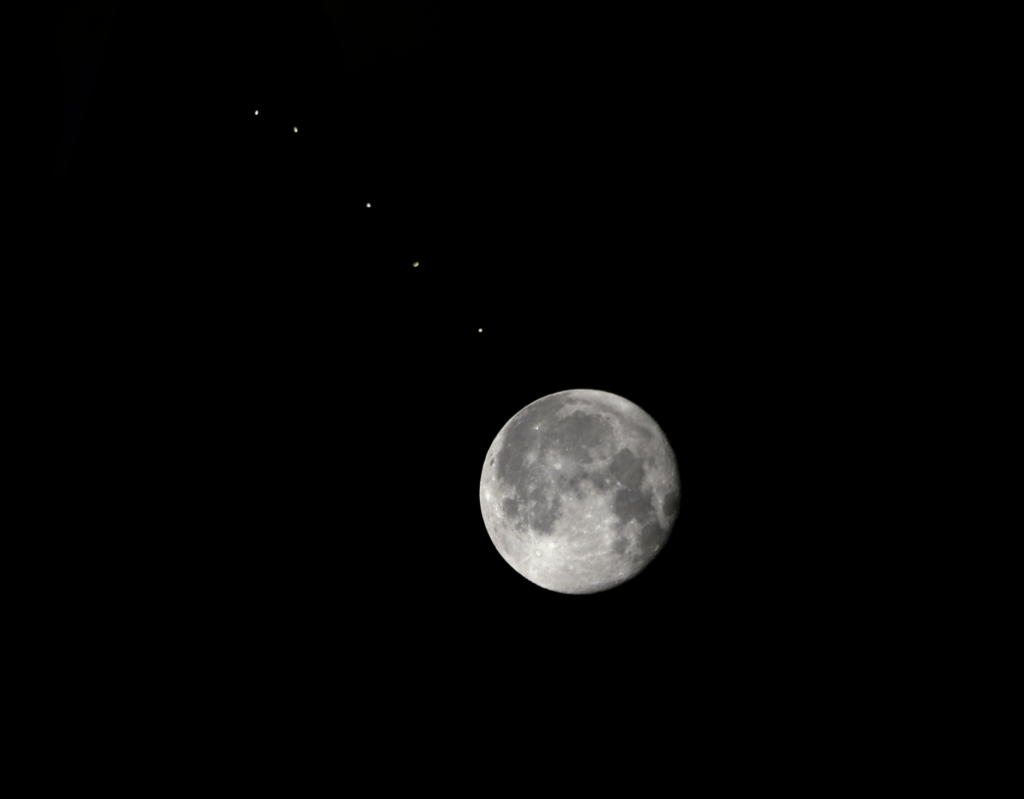
^ Composite image of the Moon occulting Saturn, taken on 21st August 2024. (Credits: Olesya Rtveliashvili)
A lunar occultation can be captured using a DSLR. Take photographs at regular time intervals leading up to it. Every time you photograph it, take two images: one of the Moon and one where the planet is bright enough on the photograph. This is because when you tune the settings in order for the planet to be detected by the camera, the Moon will appear too bright (almost Sun-like) on the image. Vice verse, when photographing the Moon with camera settings suitable for that, the planet will be too dim or not detected. After obtaining all of your images, you can overlap them to produce the final composite image.
I followed this method to capture the lunar occultation of Saturn on 21st August 2024. I waited for approximately half an hour in between most of my images. For capturing Saturn, I used an exposure time of 1/40 seconds and ISO 1000. For capturing the Moon, I used an exposure time of 1/400 seconds and ISO 100. For all of them, I used a focal length of 200mm. Then, I overlapped the images in ibisPaint. The result is the composite image clearly showing the angular distance between the Moon and Saturn decreasing before occultation. The “path” of Saturn here isn’t a straight line as the first shot was taken whilst they both were crossing my meridian.
 Star Hunters
Leave a comment