
Occasionally, two planets have a stellar meetup; in the sky, they get ever so close to each other. Yet, this planetary couple has only a few days before they must wave to each other goodbye.
What are Planetary Conjunctions?
What is it called when two planets cross close to each other in the night sky? Planetary conjunctions are when two planets (or more commonly, a planet and the Moon) appear very close to each other in the night sky. They have a small angular separation. The smaller the angular separation, the more spectacular it is. Planetary conjunctions are a celebrated event in the Astronomy community. Last August, the Mars-Jupiter conjunction was one of the most notable astronomical events of the year.
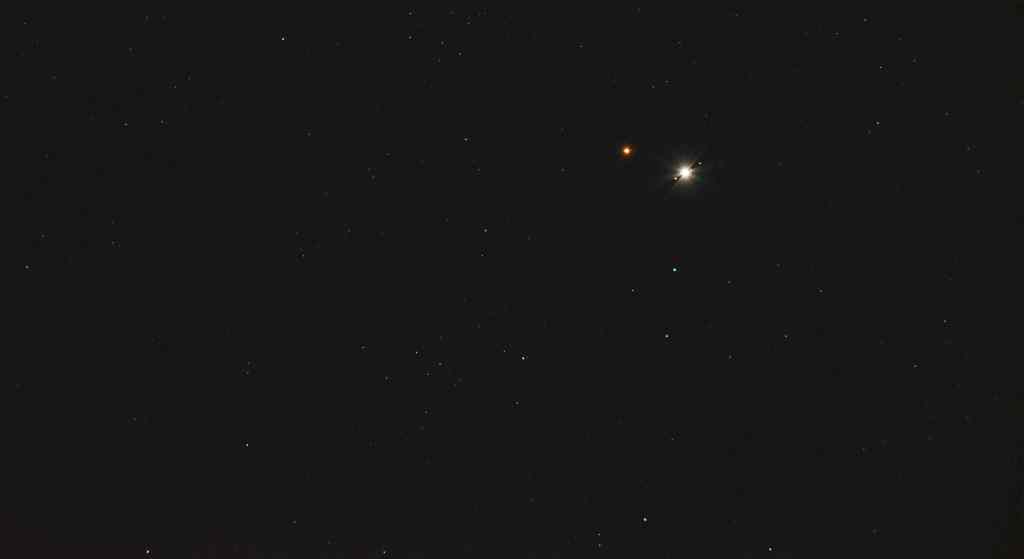
^ The Mars-Jupiter planetary conjunction, taken on 15th August 2024 (Credits: Olesya Rtveliashvili)
Occurrence
Planetary conjunctions are among the rarer events in observational astronomy. Each planet has its own orbital inclination (the angle between the plane of the Solar System and plane of orbit). Even the Moon is tilted 5.1° to the plane of the Earth’s equator! In order for a conjunction to occur, two celestial bodies must be almost perfectly aligned, which is rare due to the varying plane inclinations. Therefore, planets typically don’t “approach” close to each other in the celestial sphere. They must have the same Right Ascension. Even rarer, planetary occultations occur (although lunar occultations are more common). This is when a planet appears to pass in front of another.
The Mars-Jupiter conjunction of last year was significant as not only it involved two planets, the angular separation between them was very small. At closest, they were only 0.3° apart!
Frequency
The most frequent conjunctions are between our Moon and a planet. In particular, the easiest and most frequent ones observed involve the planet Venus, Jupiter and Saturn. Moreover, they have the highest apparent magnitude, making it observable with the naked eye.

^ Conjunction between the Moon and Venus, taken on 3rd January 2025 (Credits: Olesya Rtveliashvili)
Photographing Planetary Conjunctions
Photographing, or even just observing, doesn’t require special preparation aside from the typical. Make sure that your location has an open sky without obstruction. Weather can affect images too. Whilst this cannot be controlled, check the weather forecast to see what is expected for that day of observation.
Camera settings really depends how dim or bright the celestial bodies are. I used an exposure time of 1 second and ISO 6400 for the 2024 Mars-Jupiter conjunction. However, for the Moon-Venus conjunction above, I used an exposure time of 1/30 seconds and ISO 1000. Make sure to dedicate time for experimenting with camera settings.
After photographing, you may process the images (for example, stacking) or edit them by experimenting with colour balance.
Recently, there has been conjunctions between the Moon and Venus, Jupiter and Saturn. Next week, Mars will become part of the list. Keep a lookout for this and planetary conjunctions in the future.
 Star Hunters
Leave a comment