
Did you grow up in a rural village and see streaks of light in the sky? Or were meteors obscured by urban lights? Each year, there are notable meteor showers such as the Perseids that peaks tonight.
What is a meteor?
A meteor is essentially anything from outer space that has been pulled in by Earth’s gravity and subsequently, entered the Earth’s atmosphere. Due to air resistance, it incandesces, making it observable from the surface on Earth. For example, a piece of metal orbiting the Earth could fall through the atmosphere, lighting up and visible as a streak across the sky.
Meteor showers are celestial events and each one occurs annually. During the course of the Earth’s orbit, the planet passes through debris left behind by comets and results in many meteors “shooting” across the sky. These are spectacular – and can also show up on long-exposure images.
Fireballs are a rarer type of meteor. These are very luminous and can trail across the sky for even 30 seconds or more! This allows it to be seen from many more locations. It occurs when a much larger meteor incandesces in the Earth’s atmosphere. These three shots show a fireball as it travels across the sky:
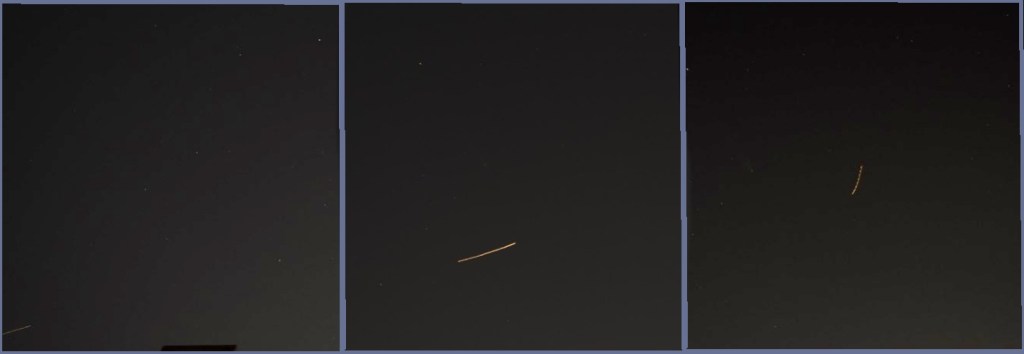
^ A fireball travelling across the sky (Credits: Olesya Rtveliashvili)
How to Observe
As with most celestial observations, it is best to observe meteor showers from an area of low light pollution and with no moonlight present. The moonlight aspect cannot be controlled unfortunately. For the best observations of the Perseids, it is best to wait next year as in 2025, the Moon will reduce the sky contrast.
Each meteor shower has a ZHR – the Zenith Hourly Rate. This is the highest number of meteors an observer could see at peak when the radiant is near/at Zenith during optimal conditions. The closer the radiant is to the Zenith (directly above your head), the more meteors are visible. The best meteor showers to observe are ones with the declination closest to your latitude.
Radiant? Peak? The radiant is the point in the sky where the meteors appear to originate from and is a result from our perspective from the surface. Meanwhile, the peak is the night of highest meteor activity.
Popular Meteor Showers
As of today, there are three meteor showers currently active. Perseids, perhaps the most popular meteor shower, peaks tonight at a ZHR of over 100. Unfortunately, moonlight will ruin any observations although it will reach the highest point at 3am BST before dawn. I recommend observing this from Northern Scotland.
The other two meteor showers are the Southern Delta Aquariids (25 ZHR) and Alpha Capricornids (5 ZHR), both of which have already peaked.
Other popular meteor showers include:
Geminids – peaks 14th December
Quadrantids – peaks 3rd January
Lyrids – peaks 23rd April
Did you know that meteor showers are named after the constellation that their radiant lies in?
Photographing Meteor Showers
There are many amazing images of meteor showers online. Some of the most phenomenal ones combine auroras, landscape composites and the Milky Way. Personally, I don’t have much experience in specifically photographing meteor showers. Occasionally, a meteor will appear in a photograph that I took. The basis of meteor shower photography involves using a wide angle lens and long exposure images. A star tracker is useful for this.
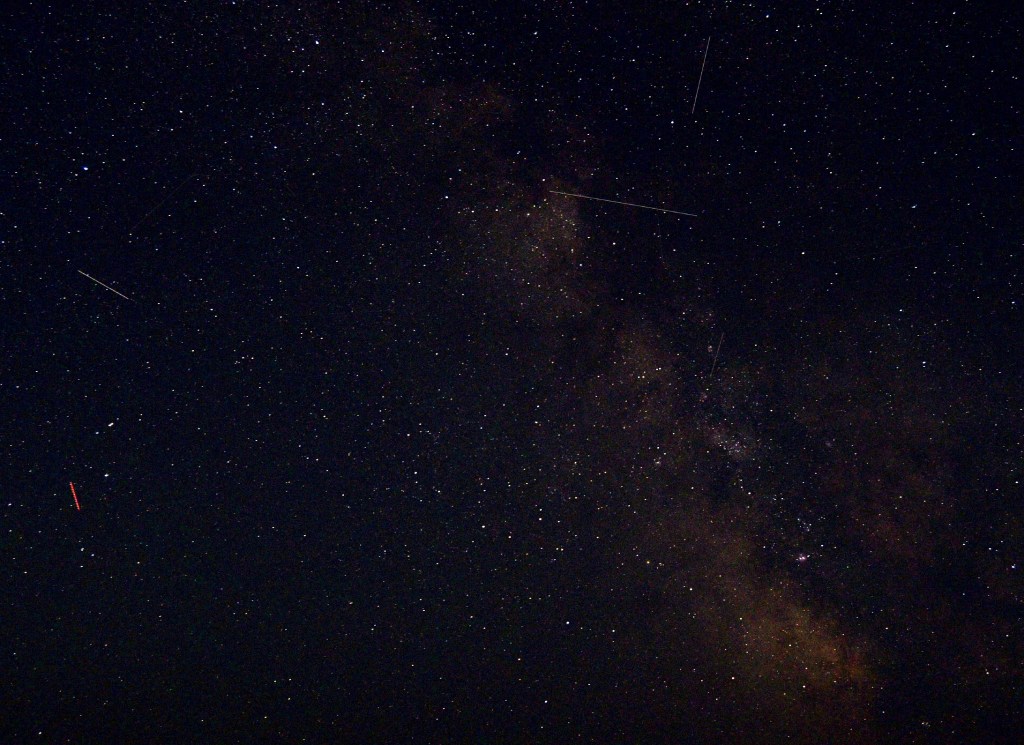
^ A (badly) edited image of the Milky Way with multiple meteors in it (Credits: Olesya Rtveliashvili)
 Star Hunters
Leave a comment