
On the 21st October 2025, a cosmic lemon made its closest approach. Well, not really a lemon, or sour and yellow. This comet was visible in the sky for a few weeks, making it the brightest comet of 2025.
What is a comet?
A comet, categorised as a Small Solar System Object, is an icy ball that orbits the Sun. Most of these have very large orbital periods and only visit the Sun every few hundred of years. When they do, the solar wind creates the two comet tails that, if bright enough, become visible in the sky. Ion tails are formed when the comet’s particles have been excited by solar wind. When they de-excite, they emit light by fluorescence. The broader dust tail is formed by solar radiation pressure pushing particles out of the comet’s nucleus.
Short period comets have orbital periods of less than 200 years. They have elliptical orbits and most originate from the Kupiter belt. A subset of this is comets with orbital periods of less than 20 years. Long period comets have orbital periods of over 200 years and many originate from the Oort Cloud. These have highly inclined, unpredictable orbits. Some are hyperbolic and even orbit in the opposite direction to planets!
Why a Lemmon?
Comet C/2025 A6 (Lemmon) was named this as it was discovered by the Mount Lemmon Observatory during a sky survey. Comets can either be named after the observatory or person that they were discovered by. There are other comet-naming conventions too.
The first letter is picked from a selection of six letters based on the orbit. The most common are P (referring to <200 year orbital periods) and C (referring to >200 year orbital periods). The number refers to the year of discovery. Looking above, this comet also has “A6”. A refers to the discovery in the first half of January (this can range from A to X) and the 6 means that it was the 6th comet discovered in that month.
What makes a comet visible to the naked eye?
Most comets are too faint to be visible with the naked eye or small instruments on Earth. In order for a comet to appear the brightest, it must be close to/at perihelion (some comets have broken up after approaching too close to the Sun), have a close approach to Earth and the alignment must be optimal. Some comets are only visible from one hemisphere due to this. It should have a large nucleus to produce bright tails and appear more illuminated. Finally, the brightest comets are the ones that have not passed near the Sun many times yet as this will decrease the nucleus size.
Photographing
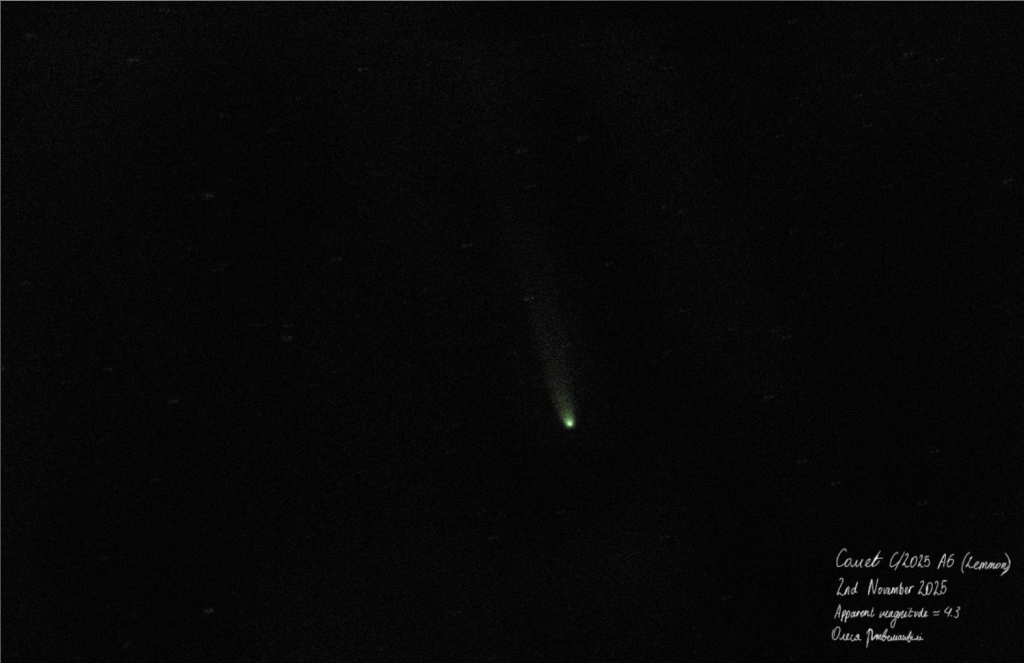
^ Comet C/2025 A6 (Lemmon) (Credits: Olesya Rtveliashvili)
Unfortunately, I do not have the correct equipment to produce comet images of good quality. My RAW images would have been better had I had access to a star tracker and used a lens with greater magnification and infinity focus. Nonetheless, I used settings of ISO 800, 5 second exposure and 200mm focal length. I stacked my images in Siril using comet-aligned stacking and tweaked the image to produce the photograph above.
 Star Hunters