
Next week, the Moon will cross the solar disc for the first time in 2026 – and this isn’t just any solar eclipse. Tuesday 17th February will witness a “Ring of FIre” in the sky.
Solar Eclipse?
Solar Eclipses are a roughly bi-annual phenomenon, occuring when the Moon’s disc in the sky crosses the Sun’s disc, allowing those located in the Umbra to experience temporary darkness: a 360° dusk. This works because fortunately, the Sun and Moon approximately subtend the same angle in the sky. Those who are located in the Penumbra (as seen below) only experience a partial eclipse; this is where the Sun appears to be “bitten”.
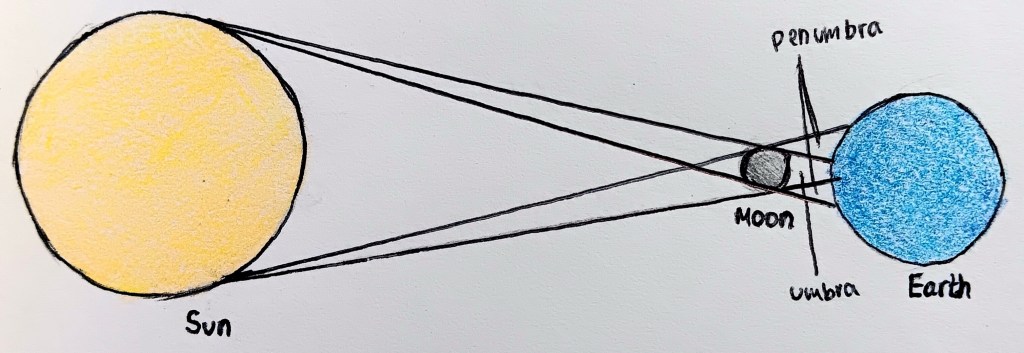
^ Diagram of a solar eclipse, not to scale (Credits: Olesya Rtveliashvili)
What makes this one so special?
Not only will this be the first solar eclipse of 2026, it will be what we call an Annular Eclipse. This is when the thin annulus (Sun) encircling the Moon appears much thicker than typical of a total solar eclipse. But it isn’t the Sun that changes size, nor the Moon. The Moon’s orbit isn’t perfectly circular but instead elliptical. When it is at its furthest point away from us, the apogee, it appears slightly smaller in the sky than normal (this is barely noticeable). Therefore, less of the Sun becomes obscured in the sky.
Unfortunately, this one will only be visible in Antarctica (although fortunate for the penguin populations and the lucky scientists situated there). Some other countries in the Southern Hemisphere will witness a partial solar eclipse, instead of the whole one.
Photographing and Hazards
If you are not prepared properly, there are significant hazards when it comes to observing the Sun. Looking directly at the solar disc can result in blindness or other severe eye injuries. The only time it may be safe to look at the disc directly is right at totality, when 100% of the Moon’s disc is blocking the Sun. Even sunglasses are not enough protection! Despite this, it is recommended to use a filter when observing with a telescope or camera because sunlight can also damage instruments. H-alpha filters are highly recommended for solar observations, albeit very expensive. A more affordable option are white light filters that block 99.9% of all sunlight, which is what I use for my solar observations.
 Star Hunters